



BitWell AMA | Apron Network如何在中间件赛道脱颖而出?
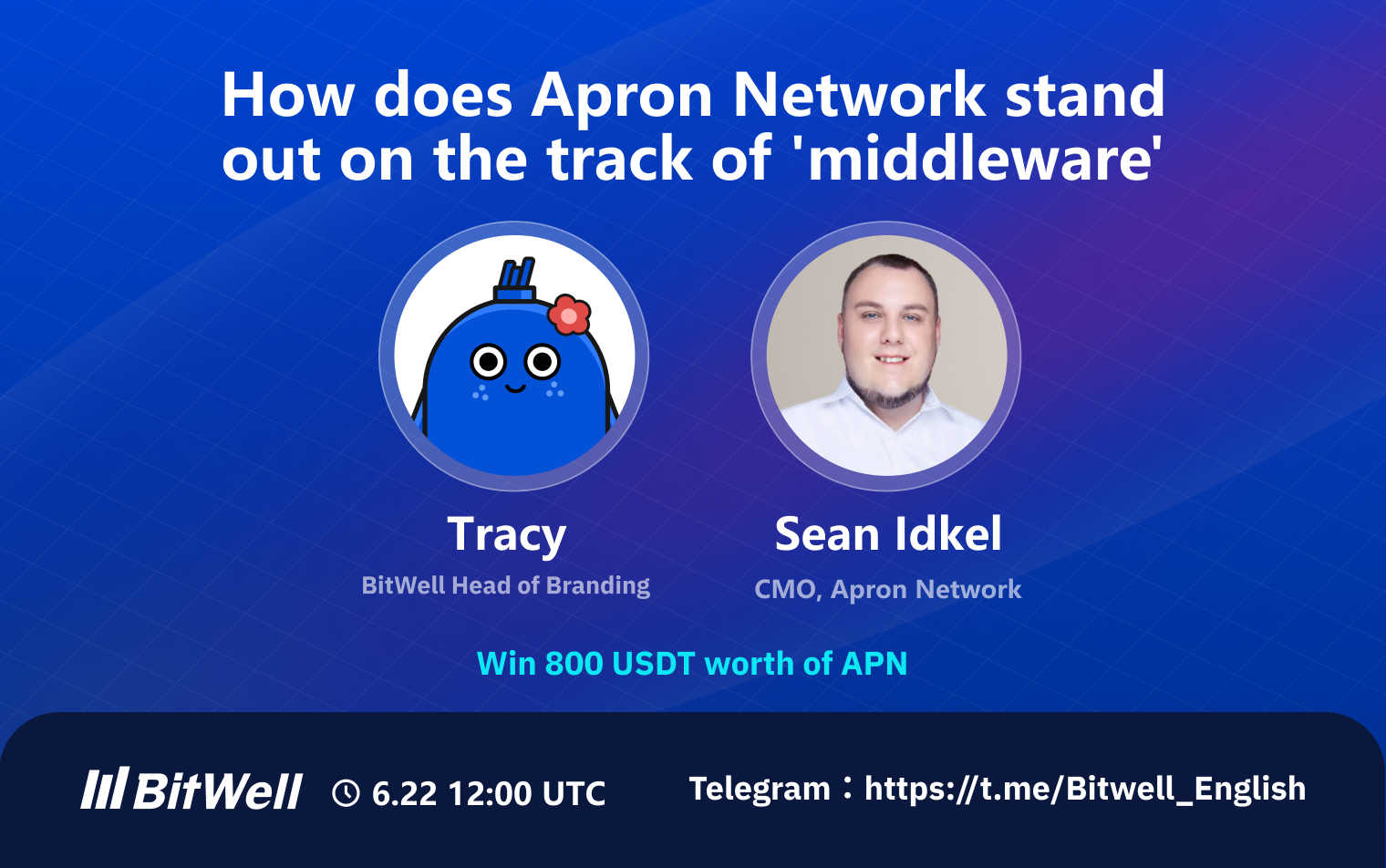
BitWell邀请到Apron Network CMO Sean Idkel做客社群,一起聊一聊Apron Network创新的中间件服务,以及未来的发展方向。
在蓬勃发展的波卡生态下,Apron Network正努力为生态提供节点服务、链上数据索引、报价等基础设施服务。Apron Network致力于解决那些目前困扰大家已久的“中心化”问题,为更多的区块链提供优质的中间件服务,使开发者可以以更低的成本使用多个区块链系统进行跨链创新。
6月22日晚20:00,BitWell邀请到Apron Network CMO Sean Idkel做客社群,一起聊一聊Apron Network创新的中间件服务,以及未来的发展方向。
以下为本次分享内容完整回顾:
1.To start the AMA, can you give me a brief introduction about your Apron?
Sean Idkel:Apron Network is a decentralized infrastructure service provider based on the Polkadot ecosystem. Apron connects infrastructure service providers to DApp developers with a decentralized service market and provides DApp and DeFi developers services to help their efficient development and rapid generation of API service interfaces. In addition, it uses decentralized billing and payment systems to bring decentralized and anonymous payments to users.
Also Apron aims to make transactions for infrastructure software services simple, efficient, and reliable by connecting service providers and users in the decentralized service market. Apron has obtained fund-raising from NGC, Monday Capital, DFG, CMS and other institutions and Web3 Foundation Grant.
Apron Network will connect to multiple public chains such as Ethereum, BSC, Filecoin, Helium, including Layer 2, providing developers with low-cost various blockchain ecological infrastructure services in the forthcoming future.
2.I see that Apron Network help developers to build Dapps using your platform so may I know about Apron Network business model?
Sean Idkel:Ofc, there are many roles involved in Apron Network, such as the Provider (infrastructure service provider), the Miner (node miner), the consumer (DApp/DeFi developers ), the Inspector (supervisor of the infrastructure services), the Delegator, and regular users.
$APN takes effective of service settlement and stimulus in the Apron Network. Participants pay $APN to use infrastructure services and obtain $APN by providing resources and construction, thereby forming an ecologically closed loop.
In order to explain in a non-technical version, I'll just put a simple business model here
1.it’s used as payment to use service paid by the customer to the service provider.
2. Apron Network will charge a certain amount of fee as the service fee as well and this fee will be burnt permanently which makes APN a deflationary token.
This is very important because as we grow and more customers come to Apron Network, more tokens will be burnt which means the value of the APN you and I are holding will increase.
3. Staking. We have several portals for our token holders to stake their APN token earning passive income and helping the network grow at the same time.
For example, we have an “inspector pool” which is for those who want a less risky staking option. Their role in the network will be simulating the real user to call the usage data, judge whether the service provider does a good job or not and whether they are providing fake data or not.
Also the service providers will need to stake some APN token as their skin in the game so to say. And if there’s bad behaviors occurred on the service provider side, they will lose the token they staked and the network will redistribute them amount the inspectors
4. We will also introduce governance(DAO) into The APN token once the network becomes fully functioning.
5. With the intention to facilitate the payment of users, we recently announced a stable coin called 'XAPN' If the stable coin channel is opened, preferential policies for APN payment will be released.
3.You say that cost-effectiveness is one of Apron's main features. How much would developers save, approximately, by using your platform compared to other projects on the market? How do you manage to reduce the costs of using your platform?
Sean Idkel:For example, if you want to develop a Uniswap or an Insurance project, you need to retrieve the off-chain data, the asset information of the user account. If you want to develop on Ethereum, you need to build a node, and the node needs to query the corresponding data. For the developer, the development project has already spent a lot of energy and cost. Nodes need to synchronize all Ethereum data of hundreds of T, and need to run an AWS server, with our interface can directly configure all the basic data.
Compare to other node projects, Apron essentially aggregates everyone who has the ability to set up their own nodes and the developers will be able to choose whoever they want to work with. And more amazing part is they can use several at the same time! So that when the volume becomes super huge, our algorithm will balance it evenly throughout all the service providers. So that it will remain stable and cost-effectively.
4.As far as I know Apron will Contribute to the Kusama slot auction. Can you explain the process of doing this? How many times will Apron bid for the position and how many weeks will it take?
Sean Idkel:Definitely! Apron will launch testnet Kpron Network on Kusama! And we are going to take part in the slot auction.
There will be 5 auctions scheduled with about 7 days between auctions. The slot auction follows a modified "****** auction." The first 2 days are an Open Period, and the next 5 days are an Ending Period. The auction will end at a random time during the Ending Period. The highest bidder at that random time is the winner.
The Kusama slot lease period is divided into 8 periods of 6 weeks each, a total of 48 weeks. After evaluating the overall situation and ROI, we decided to participate in the Kusama slot auction from the 3rd auction. Apron will first bid on 1 lease period for 6 weeks; the following bidding periods will be determined according to the actual test conditions.
Apron chose to crowdfund our slot lease using Kusama’s built-in crowdloan mechanism, which allows people to contribute by agreeing to lock up their own KSM until the end of the lease.
5.During a Parachain auction on Kusama. What is Apron's strategy on Kusama slot auction? What do we as investors have to do to participate?
Sean Idkel:Kpron Network is the testnet that Apron Network deployed on the Kusama Network. The Kpron Network’s token: KPN, is the APN on Kusama.
Apron will reward their contributors with KPN tokens. KPN was issued on Kpron Network as a portion of the tokens allocated by Apron Network and can be swapped with APN at a 1:1 rate (1KPN=1APN). There is no change on Apron’s tokenomics, and the total amount of APN remains the same.
Participating in Apron’s crowdloan activities on the Kusama network in support of slot auctions, Apron will reward contributors with a fixed return of tokens awarded for 6 weeks:
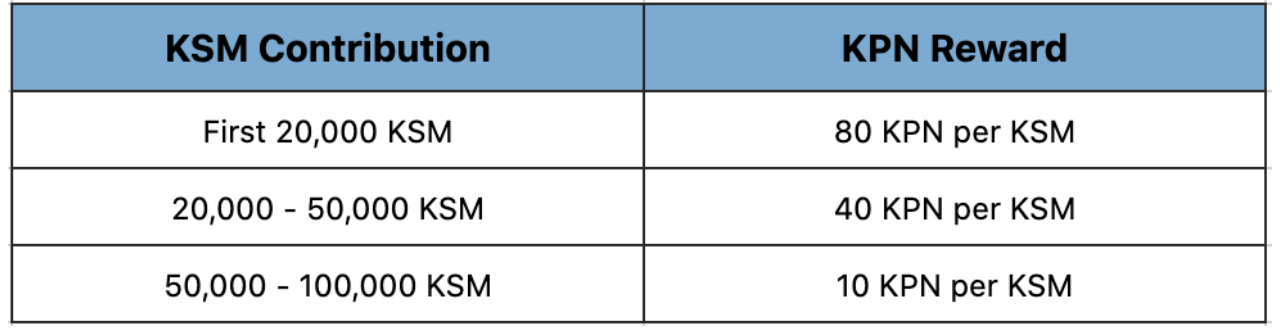
Contributors who continue to support beyond 100,000 KSM will not be rewarded
The KPN obtained can be converted 1:1 into APN.
When Kpron wins a slot and successfully runs a parachain, contributors will directly receive a 35% of corresponding rewards, 35% on the second month, and 30% on the third month.
Apron chose to crowdfund our slot lease using Kusama’s built-in crowdloan mechanism, which allows people to contribute by agreeing to lock up their own KSM until the end of the lease. 1. Campaign Index, it is the way to join from the local crowdloan, I think the Kusama will publish the guideline to teach ppl from step to step. 2. We'cooperated with some top-tier exchanges or wallets for participation as well.
6.Finally, can you give us some information about your roadmap and how #Apron Network has progressed so far? What awaits us in the future?
Sean Idkel:Personally I believe 2021 will be remembered as the beginning of Polkadot and Web3 adoption era. A singularity in some sense. We saw a variety of projects being released in the past few months and these Lego parts are being connected with one another under our own eyes. We have received the grant from Web3 Foundation and became a member of Substrate Builder Program.
And we’ll continue expand our network into different ecosystems this year. Most of the hard tech parts are already been done. From this point forward our main focus will be on marketing to attract more DApp developers and eventually achieve mass adoption.
Right now we are recruiting node providers for each public chains and it can be done in this month, that would be a milestone for the development of Apron Network. And from then on the adoption of other ecosystem would be much easier.
Certainly, if you have the ability to provide other infrasutrcure service on other public chains, we welcome you to join this recruitment program as well.
Read more:
With the continuous improvement of the network, Apron will dedicate itself to building a seamless infrastructure service platform on other public chains in Q3 and these developments will lead to the eventual launch of the Apron mainnet in Q4.
Community Q&A
1. @hieupham1797
Apron Network will provide infrastructure services such as node services, on-chain data indexes, and quotes for the Kusama, Polkadot, and Heco ecosystems. So are there any conditions for a developer to become a node in your entire network? What interest and benefits will they receive?
Sean Idkel:Anyone with the equipment to set up their nodes will be able to become a node service provider on Apron Network. And we will make the process really easy with our SDK as I said before. They will receive the service fee paid by our customer and the network itself provides a service mining reward as well. One more amazing part is our technician will always provide support and education for the layman.
2. @loichaloichoi
How Apron Network provides extra responsible security as compared to other systems? Can you please clarify in simple terms, a lot of people here are not from a technical background if you explain that in simple terms, it will help more ordinary folks like us to be cheered into your project!
Sean Idkel:Our main target customers are DApp developers since Apron Network is all about infrastructures serving web3.0 projects. Ordinary users won’t even notice our existence just like we won’t keep thinking about our sewer system but they are essential to any functioning city. To answer your question we will make our interface easy enough for any developers to us ;)
In term of security just give you one example. We offer encryption to all the services provided by service providers on Apron Network so that when someone is trying to attack our customers by trying to hack into the servers of their service providers, someone won’t even know where to shoot. They don’t know who is providing service to whom.
3.@tieuphungpro
What is the most ambitious goal of the project? How do you plan to develop the Community?
Sean Idkel:We focus on operating three types of communities, 1st is the tech community, 2nd is the service provider community, and 3rd is the token holder community. The tech community will serve to acquire customers and answer daily technical questions.
The service provider community will be used to manage service quality, assist service providers with, well, providing services, and standardize service rules.
The token holder community will be used to update with new use cases, road maps, partnerships etc. as the project progress.
We will also provide free products and techs for these holders to attract potential customers to become our future service providers or users.
From the perspective of the traditional software and information industry, Apron Network is a form of middleware service.
Middleware is an important bridge among industries. The definition of middleware is a kind of software that provides the connection between system software and application software and facilitates the communication between software components. Application software can use middleware to share information and resources between different technical architectures.
In blockchain, blockchain middleware can be understood as a kind of software that provides communication between blockchain and application software. Help developers make better use of the underlying protocol and develop applications better and faster.
Apron can be seen as an example of putting middleware theory into practice.
4. @trumdade
Could you give an overview of APRON NETWORK Token tokenomics? Will the design of the token rise and fall with the success of the platform, does it include any scarce paths, such as equity, storage or burning?
Sean Idkel:total supply: 1 Billion
Mining:55%
Institutional investment:15%
Team:5%
Consultant:3%
Marketing:9%
Parachain Lease Offerings (PLO):8%
Ecosystem Construction Foundation:5%
Apron Network will charge a certain amount of fee as the service fee as well and this fee will be burnt permanently which makes APN a deflationary token.
This is very important because as we grow and more customers come to Apron Network, more tokens will be burnt which means the value of the APN you and I are holding will increase.
Also we'll create an stable coin $XAPN as the service payment , the XAPN staking and buyback will be launched shortly.
Please stay tuned with us for further updates!
5. @MrHappy1997
The idea of the APRON NETWORK project is really unique and incredible, how did this idea come about?
Sean Idkel:I’ll explain why Apron is important for decentralization with two examples:
First of all, all projects working on blockchain need node services. That’s like the connection between DApp and underlying blockchain and all the volume happens there.
Currently most projects rely on centralized node service providers like infura because it’s too costly and time consuming for any single projects to maintain their own nodes
But here’s a problem
Around December 2020, there’s a significant incident where Binance, Metamask, Coinbase all went down at the same time for around 2 hours.
The reason behind this huge black swan event is that the node service provider these company relied on, Infura, failed to update their Ethereum node on time.
Here’s where Apron Network comes in.
We are the first decentralized infrastructure service provider trying to solve this ancient problem in such an innovating space.
We combine the force of all individuals who are capable of running a node, that is having their own server, and provide our customers with a choice of working with all of them at the same time so even when some of these node providers go down, their project won’t be affected since there are still many other node providers working for them.
These individual node providers will be able to easily join Apron Network with our Apron SDK(software development kit) and earn fee for the service they provide.
The second example actually just happened recently with the ITO of MASK.
It’s a very anticipated launch but the team had to postpone their ITO because their ROC provider QuikNode was overloaded with all the enthusiastic investors.
Again with Apron Network this wouldn’t happen since our algorithm will be able to balance the volume evenly throughout all the service provider so that they’ll not become overloaded.
Basically, Apron Network is a much safer, more convenient alternative to centralized node service providers and we envision a mass adoption within and without the crypto space of decentralized infrastructure provider in the near future.
We are here to solve a real problem that anyone in crypto are aware of. “Binance went down again” already becomes a meme now.
为你推荐

商务合作:TG:@Lottie96
Copyright 火星财经 All Rights Reserved.